
FOR GUARDIANS OF FEARFUL, REACTIVE AND TRAUMATIZED DOGS
Trauma in Dogs: Heal the Body and the Mind Will Follow
A live course with Annie Phenix, ACB-KSA, on her Body Before Brain approach: learn what she now does first with every dog she works with, so your dog can fit into your life, instead of your life shrinking around your dog’s fear.
Live on Zoom: Monday, November 2nd at 10 am Mountain time
(noon EST / 5 pm UK time)
Join for just one payment of $147 or 2 payments of $77
Annie has worked with dogs for more than 25 years, fostered more than 400 of them, and written two bestselling books on reactive and aggressive dogs.
You did everything right.
You cut up the chicken. You filled the treat pouch. You practiced at home, where your dog was a star.
Then on a walk, another dog comes around the corner. You hold the best treat you have right in front of your dog’s nose, but your dog won’t even look at it. Stiff body, hard stare, and then the barking and lunging start.
Or maybe it’s not other dogs at all. Maybe it’s the first rumble of thunder, and your dog is under the bed, panting and shaking, while the chew you slid under there sits untouched. Or it’s the moment you pick up your keys to leave the house.
You tried the class. Then another class. Maybe a trainer, or two. You’ve probably tried training, gadgets, or new routines, only to find nothing really works.
You’re not failing your dog.
The reason nothing has been working is that most training methods only teach commands. And teaching commands won’t work until the underlying trauma is addressed.
Your dog is not being bad. (S)he’s not being stubborn, and (s)he’s definitely not being disobedient.
The safety captain in their brain, the amygdala, is constantly asking: am I safe? Am I safe? Am I safe? And if a dog has enough unsafe experiences, the amygdala says, I am in charge and I will protect you. I will bark at every single dog I see. I will jump at every single thing I hear.
No treat in the world can talk them out of that. Their body remembers what happened to them, even if they don’t.
We’ve had the training industry backwards for a very long time: we focused on teaching first.
But it doesn’t matter how much or how well you teach when the student can’t take in the lesson.
That’s why harsh methods often make things worse, and even force-free training stalls when your dog is too stressed to take a treat.
No dog (or person, for that matter) can learn when they don’t feel safe.
That’s why I follow a Body Before Brain approach: We start by helping the body feel safe, and the learning follows.
And here’s the part that surprises people: When a dog’s body finally feels safe, it doesn’t take long before life gets bigger again. For your dog, and for you.
I’ve seen it with a Corgi who had 15 bites on record and had been through four trainers, two of them aversive. I saw something in his body the others had missed. He has not bitten again.
I’ve seen it with a young German Shepherd, dumped in a park, who started growling and biting anyone at his new home. His family booked eight sessions with me and only needed four.
“We are so thankful to have worked with Annie. … We’ve made incredible progress and our dog is much happier thanks to her expertise and support!“
Hazel and Shadow
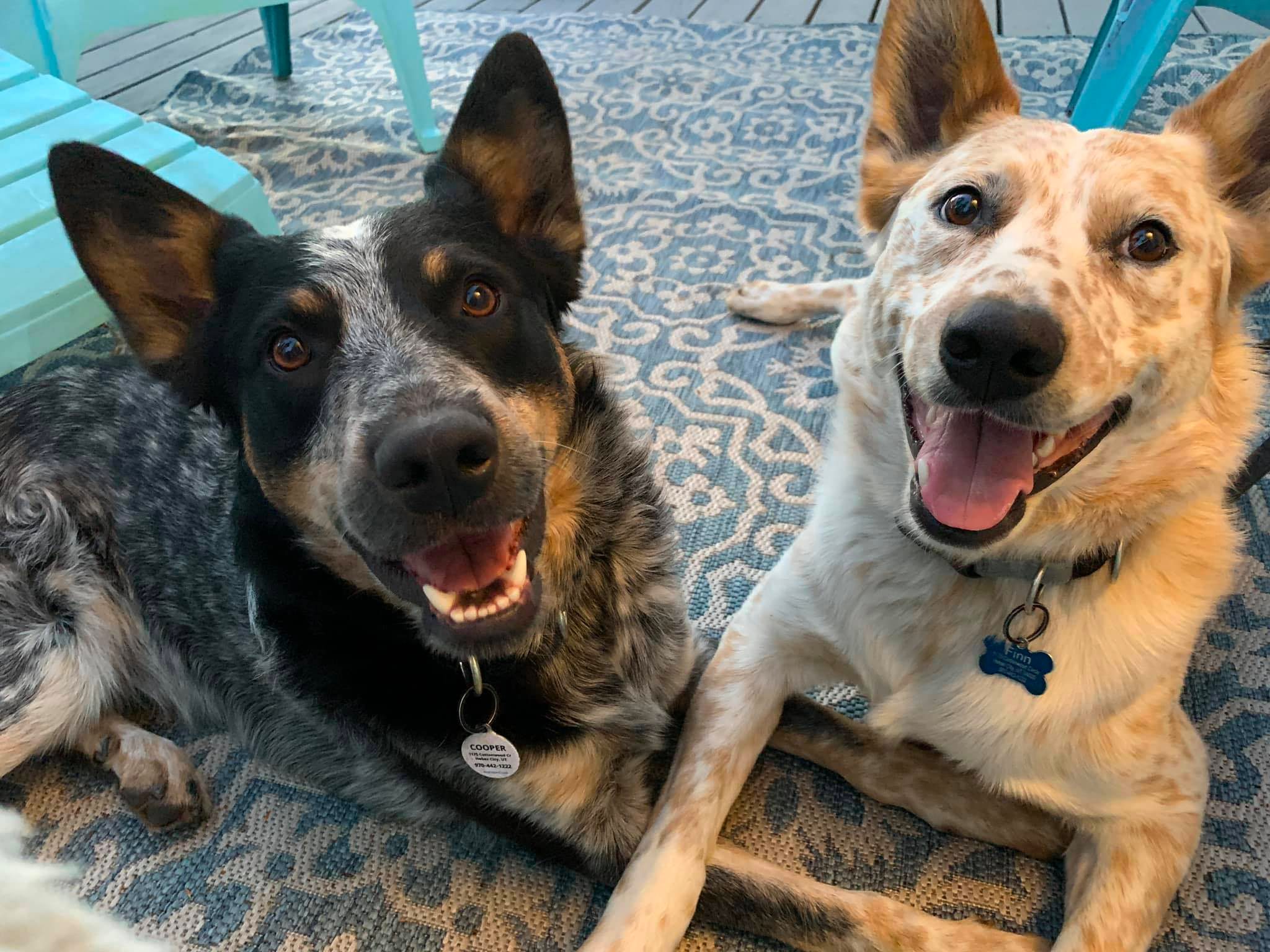
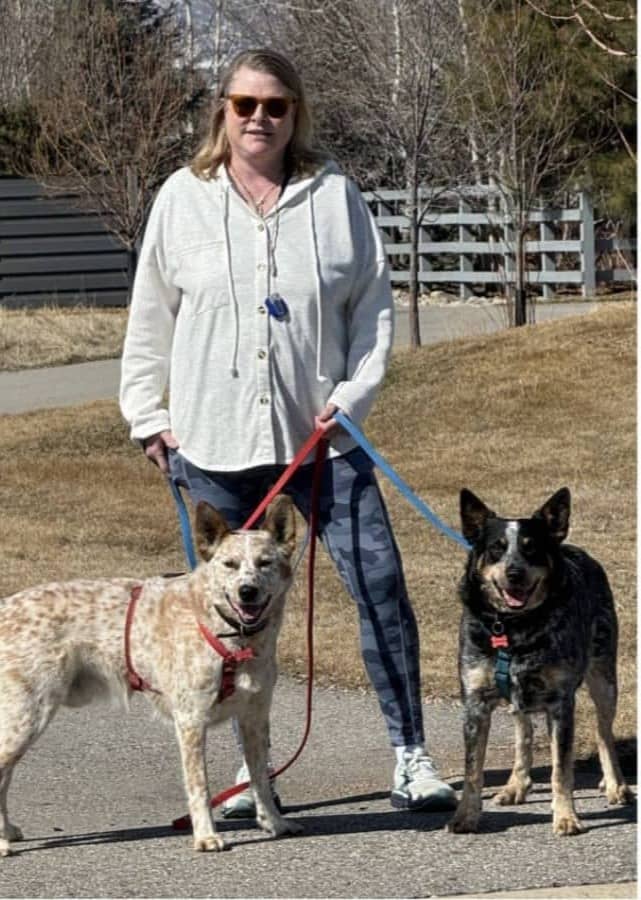
And I’ve seen it with my own dogs, Finn and Cooper.
My Heeler brothers were taken from their mother at five weeks of age and left alone in a back yard. When I got them they fought each other and were terrified of the car. At his worst, Finn would vomit and have streaming diarrhea in the car. His heart was beating so fast I thought he might have a heart attack. I tried everything, including strong vet-prescribed medication. Nothing touched it.
So I stopped trying to train them through it, and I focused on healing instead.

Finn was the most car phobic dog I have ever worked with in 25 years. Today he sticks his head out the window looking for dog friends to spot on every single journey. He invented that game himself.
This is what healing actually looks like. A dog who has found joy in the thing that nearly broke him.
Today they’re the happiest dogs I’ve ever lived with. They go places with us every week, and they love other dogs and people.
Finn and Cooper have been my greatest teachers, and what they taught me is in this course.
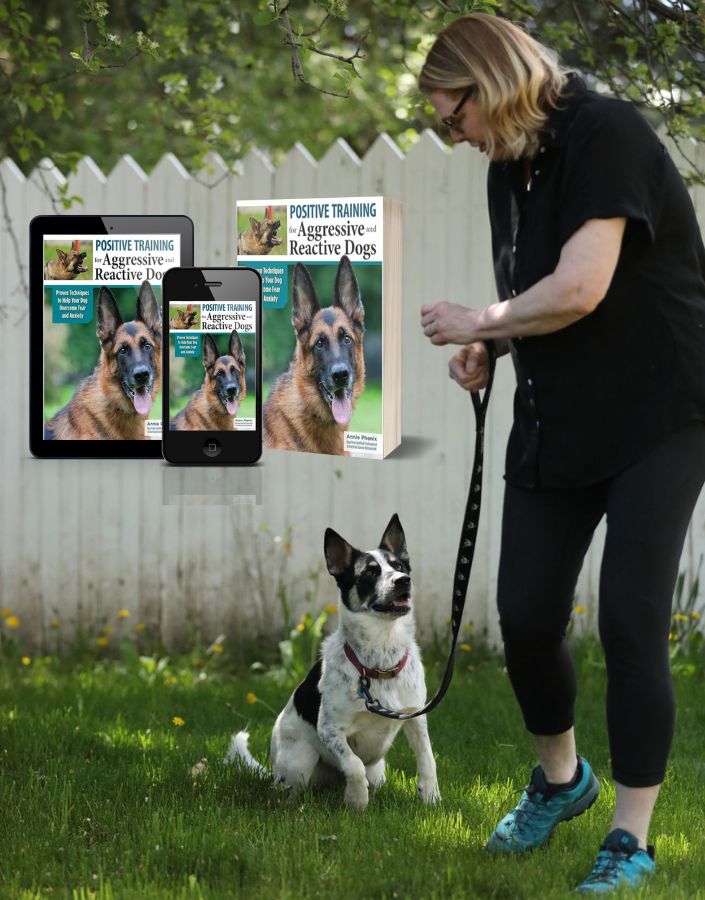
Hi, I’m Annie Phenix
I’m a professional dog trainer with 25+ years of experience and author of two bestselling books:
📖 The Midnight Dog Walkers: Positive Training and Practical Advice for Living With Reactive and Aggressive Dogs
📖 Positive Training for Aggressive and Reactive Dogs
I’ve fostered more than 400 dogs, and they taught me more than anything. I’m the founder of the Canine Trauma Clinic and the Phenix Advocacy Center for R+ canine professionals.
I understand trauma on a deeply personal level. As a survivor myself, I know how fear and stress can rewire your brain, leaving you stuck in survival mode. For the last several years I’ve been taking deep dives into the way the body responds to trauma, ours and dogs’, because they are nearly identical. That’s why we can take what we know from human healing and apply it to dog healing.
And I’m now passing what I’ve learned on to you.
Introducing: Trauma in Dogs: Heal the Body and the Mind Will Follow
A live course on the causes of trauma in dogs, the signs of trauma, and how to begin trauma recovery with your own dog.
Live on Zoom: Monday, November 2nd at 10 am Mountain time (noon EST / 5 pm UK time)
I’ll walk you through my Body Before Brain approach, what I now do first with every dog I work with, and then I’ll answer your questions about your own dog.
Can’t make it live? The recording goes into the Canine Trauma Clinic on Heartbeat as soon as it’s processed, and you keep it for life. The private channel for this course stays open, so you can keep asking questions about what’s happening with your dog and I’ll answer them there.
Dogs are individuals, so there’s no one-size-fits-all solution. What I can give you is a plan, so you know where to begin, and the order to do things in.
Here’s what we’ll walk through together:
How trauma shows up in dogs
The subtle signs your dog gives long before a growl or a bite, so they don’t have to go all the way up to a snarl
- Why a dog who stops dead on a walk is not being stubborn, and why that should set off your alarm bells
- What can cause trauma in dogs (some of it happens in the most loving homes)
Begin at the beginning
The one thing I require before I’ll work with any dog, and why half my phone calls end right there
- The behavior changes most owners never connect to their dog’s body
- What to ask your vet when they say your dog is fine
What must be stopped
What to stop for 30 days, including the one that got me the angriest mail of my career
- Do LESS Faster: what a cowboy yelling at me in a horse class taught me about frightened dogs
- How to make your dog’s home a true sanctuary
Somatic healing: helping the body feel safe
Why your dog putting his front feet up on you or the counter may be him calming himself, and why we punish it
- How much sleep your adult dog actually needs (most aren’t getting enough)
- Why I sometimes tell clients to take a book and do nothing
Glimmers
The tiny moments that tell you healing has started, and how to stop seeing only the triggers
Touch: harmful or healing?
Why so many dogs are conflicted about being petted – even if they ask for it – and how to spot it so you don’t add to your dog’s stress
Noise sensitivity as a trauma response (because it is)
The everyday household sounds that bother dogs, and the kind they react to most strongly
- When a new noise fear in an older dog points to something else entirely
- The steps I use to help a noise-sensitive dog
Your part in it
The questions I ask myself when my dog’s behavior upsets me
- How emotions are contagious between you and your dog, and which ones spread fastest
Bonus: What Somatic Healing Work Looks Like in Dogs
My recorded course on somatic healing, which opens for you inside the Canine Trauma Clinic after the live session. We go through the world body first, and so do dogs. In this course I show you what somatic healing looks like in real dogs, including the modality that finally got my boys into the car.
Once you start seeing it, you cannot unsee it.
“Annie has helped us build a better connection between ourselves and our dog. She taught us how to read his cues so that we can communicate better and as a result, I feel that our dog, Charlie, can live a more fulfilling life. The training has felt like much more than just commands or activities, it is a more holistic way to view the life you want to have with your dog.”
Marty P.
Add The 30-Day Trauma Reset (optional but highly recommended)
The live course shows you why healing comes first and where to begin. The 30-Day Reset is the step-by-step plan that walks you through it, day by day, so you never have to wonder what to do next.
It’s a simple protocol to help your dog process fear, calm their nervous system, and build trust, all in just 5 to 10 minutes a day. Thirty micro video lessons of 2 to 7 minutes each, starting with Deep Safety in week one and ending with moving from survival mode to curiosity and joy in week four.
The Reset is normally sold for $147.
Everything you need to help your dog start to heal
When you join, you’ll get instant access to the Canine Trauma Clinic community platform on Heartbeat (if you’re not already a member) and the Zoom link for the live call on November 2nd.
You’ll receive:
✅ The 120-minute LIVE Zoom call where I walk you through my my Body Before Brain approach.
Join me live and get your questions answered right there and then, during the Q&A section of the call, right after the class
Monday, November 2nd at 10 am Mountain time (noon EST / 5 pm UK time)
✅ Lifetime access to the recording
Whether you miss the live call or want to watch again later, the recording is there for you.
✅ Private forum to get answers to your questions
If any questions come up as you apply what you learned to your dog, simply ask in the private forum inside the Canine Trauma Clinic Heartbeat community, and Annie will give an answer personalized to your dog.
✅ Bonus Course: What Somatic Healing Work Looks Like in Dogs
This course will be available inside the Canine Trauma Clinic community platform AFTER the live session.
✅ If you choose to add it: The 30-Day Trauma Reset
This course will be available inside the Canine Trauma Clinic community platform AFTER the live session.
✅ Access to our private community space
Want to connect with like-minded dog lovers? Want to celebrate a win or share a tough moment? Our supportive community is here for you, every step of the way.
You’ll have all the tools and the support you need to finally stop feeling stuck, and start helping your dog feel safe.
Is this for you?
This course is for you if:
- Your dog is fearful, reactive, noise phobic, car phobic, or struggles to be left alone, and you know or suspect something in their past is behind it
- You’ve tried absolutely everything else, and nothing really changes
- You believe it’s a choice how we train dogs, and you choose to not use force
- You want your dog to heal, not just be managed
- Canine professionals are welcome too. If you work with fearful dogs, this is how I now begin with every client dog.
This course is not for you if:
- You want a blueprint that treats every single dog the same
- You’re not willing to change some of what you’re doing right now
- You’re looking for another obedience program
Save your seat
Create that sense of safety first, and training and living with your dog gets so much easier, with far fewer problems along the way.
Purchase the Course
Trauma in Dogs: Heal the Body and the Mind Will Follow
- Live course with Q&A
- Lifetime access to the recording
- Private course channel
- BONUS: somatic healing course ($47 value)
Purchase the Course + The 30-Day Trauma Reset
Trauma in Dogs: Heal the Body and the Mind Will Follow
- Live course with Q&A
- Lifetime access to the recording
- Private course channel
- BONUS somatic healing course ($47 value)
- The 30-Day Trauma Reset course ($147 value)
This offer closes when we go live
We go live on November 2nd at 10 am Mountain Time, and that’s when this offer closes. After that, the bonus course and adding The 30-Day Reset for $50 will be gone.
What happens after you join
Right after you join, you’ll get an invitation to the Canine Trauma Clinic on Heartbeat, where you’ll find the details for the live call.
The bonus course, and The 30-Day Reset if you added it, open after the live session. That way you start with the why, and then move on to the day-by-day how.
Picture this
A quiet afternoon, a little while from now. Your dog is asleep on the couch, on his back, all four paws in the air. He didn’t even stir when the delivery truck pulled up.
On your walk, another dog turns the corner. Your dog looks. Then he gives himself a big shake, turns back to you, and takes the chicken from your hand.
The next time it thunders, he’s still not a fan. But he’s on his bed with his chew, not shaking under yours.
When you pick up your keys, he watches you go and stays put.
You’ve had friends over for dinner again. You take him places, and he comes along because he wants to.
And you notice something about yourself, too. You’ve stopped bracing every time you step outside, and you’ve stopped apologizing to strangers.
Your dog stops being a problem to manage. He’s just your dog again. He fits into your life, instead of your whole life being arranged around his fear.
It won’t all happen at once. It happens in glimmers: a deep nap here, a lean into your leg there. But glimmers build, and that’s what healing looks like.
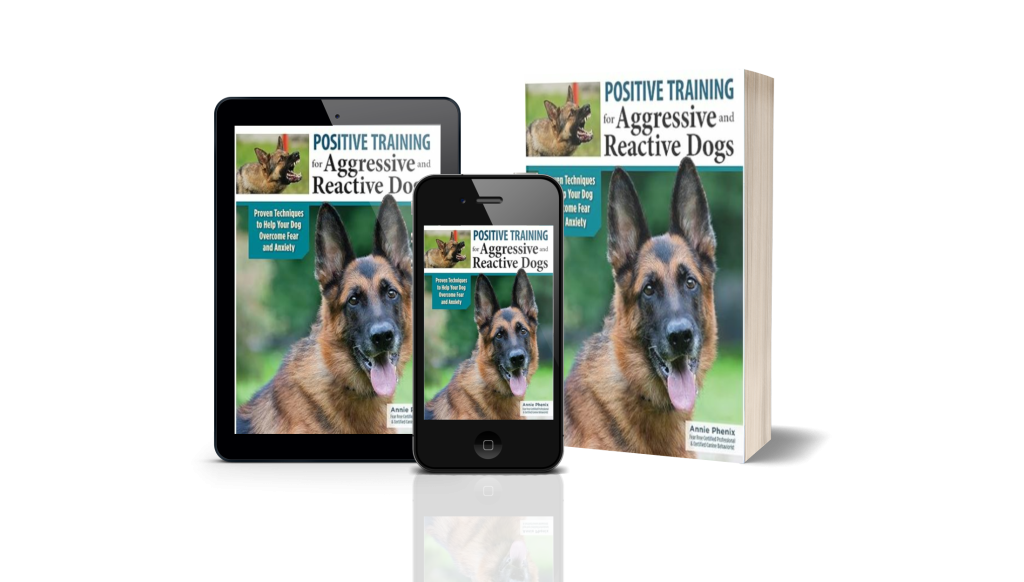
What people have said about Annie’s bestselling book Positive Training for Aggressive and Reactive Dogs
Read more stories from Annie’s clients on the testimonials page.
Frequently Asked Questions
Are you saying I shouldn’t train my dog?
No. I train my dogs for the few things that are important to me, like a recall. Don’t go out and say Annie Phenix said don’t train your dog. That’s not what any of us are saying. Safety first, then training.
Is this force-free?
100%. Science and compassion are our only tools. Our training is based on respect and aims to create deep safety for dogs. There is no room for any methods or tools based on fear.
How much time does this take?
Set aside 2 hours for the live course. After that, a few minutes a day will go a long way. Healing starts with doing less.
My vet says my dog isn’t in pain.
Pain can be hard to detect, particularly in a veterinarian’s office where the dog is already high on adrenaline. I’ll talk about what to look for and what you can ask for.
I’ve tried other things and nothing worked. How is this different?
Most “solutions” treat symptoms. This course goes deeper – it’s trauma-informed, based in canine body language, emotional safety, and real choice. It’s not a trick. It’s true healing.
How long will I have access to the course?
You’ll have lifetime access to the recording and the private course forum to ask any questions that come up as you apply what you learn in your home with your dog.
What if I miss the live session?
The recording goes into the Canine Trauma Clinic on Heartbeat as soon as it’s processed, and you keep lifetime access. You can post your questions in the private course channel and I’ll answer them there.
I don’t know what happened to my dog. Can I still help?
Yes. A lot of times we adopt dogs and we don’t know their history. We can tell by their behavior that something has scared them. You don’t need the story to start helping the body feel safe.
My dog has been this way for years. Is it too late?
No. I’ve seen dogs start to heal at eight or nine years old. The Corgi I mentioned was six, with 15 bites on record, and he has not bitten again. Every dog is different, so I won’t promise you a timeline.
I already have The 30-Day Reset.
Then check your inbox. I’m sending Reset owners a special price for this course, bonus included. Can’t find it? Get in touch.
Still Got Questions?
Get in touch: https://choosetotrainhumane.com/contact-us/
Now You Have a Choice
You can keep doing what you’ve been doing…
Trying random tips.
Avoiding outings.
Feeling anxious before every walk or visit and guilty afterward.
Or you can do something different.
You can help your dog feel safe.
You can finally understand what’s really going on — and how to change it.
You can reclaim the life you imagined when you brought your dog home — one where you go places together with joy and confidence.
You don’t have to wait for “someday.”
Healing can start today.
So what’s your next step?
I look forward to seeing you inside.
Annie
Where to go next
Whether or not this course is the right fit for you and your dog, here are three other ways I can help.
The 30-Day Trauma Reset
The underlying work. Five to ten minutes a day for thirty days to help your dog feel safe again.
Talk to Annie directly
Book a 60 minute video consult from anywhere in the world. We look at your dog together and leave you with a plan.
Start for free
7 Steps to Quick Healing: a short guide with seven practical things you can do this week to help your dog feel calmer.